
專任教師
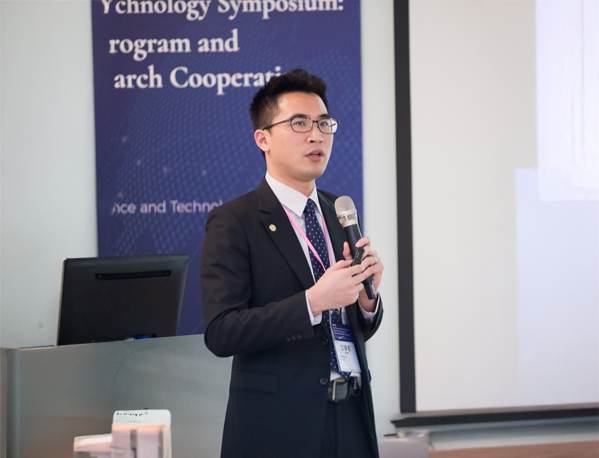
教授
江偉宏Wei-Hung Chiang
聯絡方式
- E-mail.whchiang@mail.ntust.edu.tw
- 教師辦公室號碼.02-2737-6647
- 實驗室號碼.02-2733-3141#3750
- 傳真.02-2737-6644
- 辦公室位置.E2-514
- 實驗室位置.E2-510 (前瞻材料與微電漿實驗室實驗室)
- 實驗室網站.https://scholar.google.com/citations?user=GuP1tOsAAAAJ
研究專長
- 奈米/量子材料合成與應用、電漿製程與應用、臨場光譜分析技術、綠色製程
學歷Educational qualifications
- 2009 Ph.D. in Chemical Engineering, Case Western Reserve University, USA
- 2003 B.S. in Chemical Engineering, National Taiwan University, Taiwan
經歷experience
- 2017-present Associate Professor, National Taiwan University of Science and Technology, Taiwan
- 2013-2017 Assistant Professor, National Taiwan University of Science and Technology, Taiwan
- 2011-2013 Researcher, Industrial Technology Research Institute, Taiwan
- 2010-2011 Postdoctoral Scholar, National Institute of Advanced Industrial Science andTechnology, Japan
研究主題
- 量子點增強拉曼散射材料合成與高靈敏生醫感測技術開發(科技部研究計畫)
- 碳循環量子材料合成與光化學感測應用(科技部研究計畫)
- 低維度材料飽和吸收體應用於超快雷射技術開發(科技部研究計畫)
榮譽獎項
- 2021科技部吳大猷先生紀念獎
- 2022,2020臺灣科技大學研究傑出獎
- 2020臺灣科技大學教學傑出獎
- 2015台灣化工學會優秀學術勵進獎
- 2015臺灣科技大學優秀年輕學者獎
教師選列著作
- Darwin Kurniawan, Bai Anjali, Owen Setiawan, Kostya (Ken) Ostrikov, Yongchul Chung*, andWei-Hung Chiang*, "Microplasma Band Structure Engineering in Graphene Quantum Dots forSensitive and Wide-Range pH Sensing", ACS Applied Materials & Interfaces (2022) 14, 1, 1670-1683
- Darwin Kurniawan, Owen Setiawan, Ken Ostrikov, and Wei-Hung Chiang*, "MicroplasmaNanoengineering of Emission-Tuneable Colloidal Nitrogen-Doped Graphene Quantum Dots asSmart Environmental-Responsive Nanosensors and Nanothermometers", Carbon (2021), 185,501-513
- Darwin Kurniawan, Rong-Chen Jhang, Ken Ostrikov, and Wei-Hung Chiang", "Microplasma-Tunable Graphene Quantum Dots for Ultrasensitive and Selective Detection of Cancer andNeurotransmitter Biomarkers", ACS Applied Materials & Interfaces (2021) 13, 34572-34583
- Ye-Jui Yeh and Wei-Hung Chiang", "Ag Microplasma-Engineered Nanoassemblies on CellulosePapers for Surface-Enhanced Raman Scattering and Catalytic Nitrophenol Reduction", ACSApplied Nano Materials (2021), 4, 6364-6375
- Jhih-Siang Yang, Yi-Chen Chang, Quan-Hou Huang, Yu-Ying Lai", and Wei-Hung Chiang' "Microplasma-Enabled Nanocarbon Assembly for Diameter-Selective Synthesis of ColloidalGraphene Quantum Dots", Chemical Communications (2020), 56, 10365.
- Darwin Kurniawan and Wei-Hung Chiang "Microplasma-Enabled Colloidal Nitrogen-DopedGraphene Quantum Dots for Broad-Range Fluorescent pH Sensors", Carbon (2020), 167, 675-684
- Wei-Hung Chiang Davide Mariotti, R. Mohan Sankaran, J. Gary Eden, and Kostya (Ken)Ostrikov*, "Microplasmas for advanced materials and devices", Advanced Materials (2020), 32,1905508
- Chi Van Nguyen, Seulchan Lee, Yongchul G. Chung,* Wei-Hung Chiang,_ and Kevin C .- W. Wu*,"Synergistic effect of metal-organic framework-derived boron and nitrogen heteroatom-dopedthree-dimensional porous carbons for precious-metal-free catalytic reduction of nitroarenes",Applied Catalysis B: Environmental (2019), 257, 117888
- Jhih-Siang Yang, David Z. Pai, and Wei-Hung Chiang*, "Microplasma-enhanced synthesis ofcolloidal graphene quantum dots at ambient conditions", Carbon (2019), 153, 315
- Manna, K, Huang, H .- N., Li, W-TI, Ho, Y-H, and Wei-Hung Chiang, "Toward Understanding theEfficient Exfoliation of Layered Materials by Water-Assisted Cosolvent Liquid Phase Exfoliation",Chemistry of Materials (2016), 28, 7586-7593.
